So, I fail in keeping a blog updated.
Here is something I wrote for someone else about the importance of reading literature when involved in ministry. You don't have to be a pastor; I do think it's applicable to anyone who is in a position to reach out to their neighbor, which, as it happens, is everyone.
Hopefully a real post will be coming soon...
Monday, October 1, 2012

Sunday, April 1, 2012
The Games
My thoughts on The Hunger Games
*Even though I’m probably the last person who cares to have read these books, just to be fair: SPOILER ALERT!!!
 Full disclosure: After I read the first book in this series, I was fully prepared to despise and condemn the entire thing. Admittedly, I am not very familiar with young adult literature. I thought that to call the writing mediocre would be a compliment, and the popularity of a dark and violent story made me nervous. Typically, I am one of the last people to react against literature with dark undertones or “unhappy” endings (if I had to pick a favorite author, one I might name would be Thomas Hardy, a man notorious for his hopeless characters and depressing depictions of humanity). However, I do take issue with an audience that indiscriminately enjoys darkness, particularly violence, without heeding a deeper purpose or seeking to understand their own fascination. I have heard the series condemned for violence that is not fully understood and praised for no merit aside from an “interesting plot.” I have actually heard and read comments from Christians who said that the book was okay because, even if it is violent, it is free of sex and nudity and “the really bad stuff.” These kinds of attitudes have frustrated me before, and after reading the first novel, I was ready to quit. I struggled to understand what it was exactly that was drawing people to both the book and the movie. After the first book, I thought that all I held in my hands was a weak and poorly developed character who entertained readers with her fight for survival in very much the same way the Hunger Games entertained those people sitting comfortably in their lives in the Capitol.
Amazingly enough it was seeing the movie that first started to change my mind about the series; and, by the end of the third and last book, I was actually impressed.
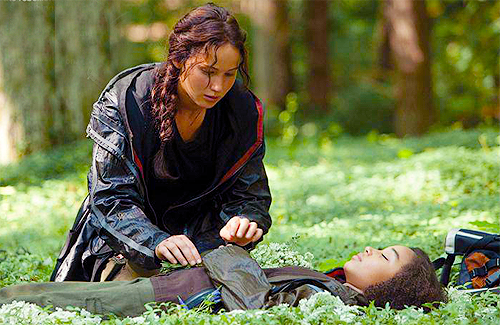
Honestly, I had very little desire to see the movie. I was disgusted with the popularity of what I saw as a pointlessly bloody story and was squeamish at the thought of watching teenagers battle to the death on-screen. Social media sites were blowing up with people excited about both the book and the movie version of The Hunger Games, and I’m not one to be thrilled about jumping on a blockbuster band wagon. But it was one of those things where I wanted to hang out with some friends for a “girls’ night out” and the movie was the general consensus. Not being one to argue, I sucked it up, bought my ticket for opening weekend, and dreaded the movie for two weeks. By the time the night came, I was half way through the second book and increasingly frustrated with myself for not being able to see what the draw was, but also frustrated with my own fascination with the plot line.
I think the reason I ended up appreciating the movie so much was the simple fact that they took the dark violence of the book and did not try to lighten it for a PG13 film. The violence was violent, though not gory; and the characters realistically struggle with their plight. In my mind, movie does not necessarily merit the “team Gale, team Peeta” Twilight mentality that has been forming amongst the more immature fans.
The movie was admirable, the audiences less so. I am disheartened by the number of people treating the story in the very way the novel actually does a decent job speaking against. Not only are people taking sides in a relatively unimportant romance, but I’ve heard stories of theatre audiences who actually cheered for the deaths of other competitors in the on-screen version of the first novel. In general, people are not searching for the deeper meaning of the text, which is really pretty obvious by the end, but are instead allowing themselves to be entertained by the very dark violence that the series attempts to depict as despicable, if sometimes inescapable.

For the sake of time and the purpose of not boring you to death with my ranting against peoples’ inhumanity, allow me to simply conclude with my thoughts on the ending of the series that so pleasantly took me by surprise.
I have heard the ending condemned for being too harsh and unhappy, but I would almost argue that it is perfect. I believe readers are attracted to Katniss because she is the imperfect anti-hero, and in the end it could be argued that she is not the hero of the series at all. Katniss is thrown into a position where she is fighting for her survival and that of her family. She is moral enough to not want to kill Peeta outright and eventually appreciate his efforts to keep her alive enough to return the favor. But she is quite literally a pawn in the games of the Capitol and District Thirteen, and this is the problem she struggles with as she also tries to survive and develop into a fully self-conscious character. Katniss has too many flaws to be a true hero and does not begin her process of healing from her violent existence until the end of the series when it seems like everything has actually fallen apart. Some may argue that the point of Katniss’s healing and self-awareness comes when she kills Coin instead of Snow, or when she realizes that she is truly in love with Peeta. However, though I think it is a combination of events, I believe Katniss’s healing begins to be most evident when she realizes that, though he has been vital to her existence and survival, Katniss is better off without Gale. There is no “team Peeta” and “team Gale” because, in the end, Katniss must be with Peeta if the revolution has truly worked to draw her closer to the altruistic nature that humanity is to strive for. Gale represents the violence of the revolution with his brutal reaction against the cruelty of the Capitol. However, by reacting with hatred and violence, Gale continues to kill the innocent, possibly even Katniss’s sister, Prim. This is also the way that Katniss tries to react, and she would likely continue in hatred and with violence if not for the gentle and peaceful nature of Peeta. Peeta is not shy about focusing on survival, but neither does he allow hatred to overcome him except when unnaturally forced by the Capitol torture, and even this he eventually overcomes. Katniss cannot realize that it is Peeta she needs until she has been completely broken to a point where only his gentleness can begin a process of healing. But first, Katniss had to let go of the violence that was the initial inclination of humanity. Just as humanity is evolving for oppression to revolution to peace, Katniss must go through the same process. If she becomes stuck in the “Gale stage,” she will only begin the cycle of violence and hatred again and again. It is Peeta who is arguably the true hero and his attitude that promises the salvation of humanity.
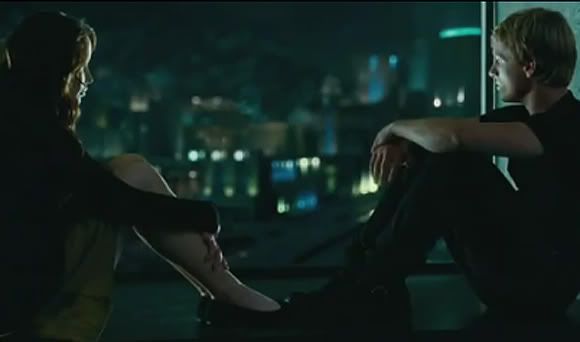
By the end of the series, I realized that it is not the violence and survival story that is important, and this should not be what is drawing audiences. The series has a number of important themes, but a main one is certainly speaking for humanity’s healing from oppression and violence rather than the continuance of the same. The series shows (though not perfectly) a cycle that must be broken rather than continued with reactions that are always the same story of death and destruction. Katniss and Peeta and their children are the beginning of a new evolution of humanity that remembers cruelty but does not enact it in order to have freedom. The books are not about simply surviving “the Hunger Games” but actually breaking free from them in order to gain a new type of prosperity.
I only hope that as the second and third movies are made, audiences will come to better understand the meaning of the series instead of mindlessly taking them in as the very entertainment they should cause people to react against. Perhaps this is wishful thinking to assume of our western culture that has been saturated with the “okay-ness” of violence and war in society. I suppose the least I can do is to call for anyone reading this to please think more critically not only about these books, but about your reaction to any form of popular “art” or entertainment as these are the things that often drive our perception not only of the world but of ourselves.
Wednesday, November 2, 2011
Some Not-So-Structured Thoughts on Theory
"I learned to read and to love books much as I learned to know and to love Rome: not only by intuiting undisclosed passageways everywhere but also by seeing more of me in books than there probably was, because everything I read seemed more in me already than on the pages themselves." --Andre Aciman from "Intimacy" in Alibis: Essays on Elsewhere
I was recently struck by yet another author profile in Poets&Writers. Aciman is not only a writer who had a previous career in advertising but also an executive officer of a prominent comparative literature program, which makes his take on literary theory even more surprising.
Speaking of his graduate studies, Aciman says that he "was enthralled" by literary and cultural theory (Derrida, Foucault, Todorov, etc.) and "loved the idea of theory becoming so important." However, with experience, Aciman eventually changes his mind. Instead, Aciman sees theory as something of a threat to intellectual pursuits: "I think there's a lot of nonsense going on [in universities]...It's okay to be an academic. It's okay to be a scholar. But you also have to be an intellectual, and intellectuals have a different mission. They need a commitment to the excellence of the life of the mind, which I don't think has much to do with body politics. There are far more important issues that exist and need to be discussed. What is a human being? What is life? I think most literature is about that in one way or another and it transcends identity politics...What passes for intellectual engagement today is just an interest in current affairs."
I know that's a lot of quoting. And I don't even agree with Aciman entirely. But this section of the article strikes me because it seems as though Aciman is articulating my very own struggle with wedding creative and beautiful work with the stark outlines of literary theory. As Aciman says, "There's something about beauty that is difficult to talk about, so people talk about structure."
 This is precisely the problem. How does one define beauty? How can we answer those questions about the nature of life and humanity? Art has been striving to do these things for literal ages. Aciman posits that to be a true intellectual, one most not focus only on societal structures but also see a deeper, more spiritual, and more elusive side of literature. Though I am still enthralled by my own theory love-affair, finding theory both interesting and useful, it is true that the cultural concepts and social aspects are not what "stick with me" when I am finished reading a book. The ending of The Amazing Adventures of Kavalier and Clay does not bring tears to my eyes (every time I read it) because it makes a statement on what it meant to be homosexual in mid-20th century America. The Elegance of the Hedgehog does not cause me to quiet myself into contemplating the simple beauty of life and question structured religion because loosely Buddhist characters cross socioeconomic boundaries. No, these books have something more that strikes the soul and not just the mind. It is this "something" that first drew me (and many others) to not just appreciate but literally fall in love with the art of stories.
In my mind, I think I secretly see this "something" as a sort of "literary divine." It can be felt and, to some extent, understood but not necessarily firmly grasped. This, in turn, leads me to another thought that I only wish to touch upon briefly as it is newly conceived in my process. I wonder if maybe Christians embrace theory (which is not always true if those theories contradict "Faith") even more readily than seeing a "self," or "divine," if you will, in literature--specifically secular literature (or art in general for that matter). We can better explain more concrete political and social theories about the world; sometimes we are even lucky enough to be able to fit them into our own "Christian narrative." But how dare we use art to tap into a deeper meaning that (though often unspoken) is only found in Christ and the Gospel.
Why are we so afraid of trying to answer questions like "What is it to be human?" and "What is life?" using literature?
 Perhaps I venture too far. It is true, Scripture provides relevant answers to these questions. But does this mean we should stop short at a 2000+ year old text without seeking more understanding that comes out of our very own culture?
I fear that I'm not being very clear as I try to disentangle this thread of thought to weave together my own theory of art and literature. I have the haunting suspicion that this is something I will always be working on and, for now at least, my musings are far from fluid. Somewhere there are loose ends of physical and spiritual beauty embodied in art tied with cultural and religious narratives knotted together into a big mess of theoretical misunderstanding. But we'll get there. And if we don't, the process must count for something.
I was recently struck by yet another author profile in Poets&Writers. Aciman is not only a writer who had a previous career in advertising but also an executive officer of a prominent comparative literature program, which makes his take on literary theory even more surprising.
Speaking of his graduate studies, Aciman says that he "was enthralled" by literary and cultural theory (Derrida, Foucault, Todorov, etc.) and "loved the idea of theory becoming so important." However, with experience, Aciman eventually changes his mind. Instead, Aciman sees theory as something of a threat to intellectual pursuits: "I think there's a lot of nonsense going on [in universities]...It's okay to be an academic. It's okay to be a scholar. But you also have to be an intellectual, and intellectuals have a different mission. They need a commitment to the excellence of the life of the mind, which I don't think has much to do with body politics. There are far more important issues that exist and need to be discussed. What is a human being? What is life? I think most literature is about that in one way or another and it transcends identity politics...What passes for intellectual engagement today is just an interest in current affairs."
I know that's a lot of quoting. And I don't even agree with Aciman entirely. But this section of the article strikes me because it seems as though Aciman is articulating my very own struggle with wedding creative and beautiful work with the stark outlines of literary theory. As Aciman says, "There's something about beauty that is difficult to talk about, so people talk about structure."
In my mind, I think I secretly see this "something" as a sort of "literary divine." It can be felt and, to some extent, understood but not necessarily firmly grasped. This, in turn, leads me to another thought that I only wish to touch upon briefly as it is newly conceived in my process. I wonder if maybe Christians embrace theory (which is not always true if those theories contradict "Faith") even more readily than seeing a "self," or "divine," if you will, in literature--specifically secular literature (or art in general for that matter). We can better explain more concrete political and social theories about the world; sometimes we are even lucky enough to be able to fit them into our own "Christian narrative." But how dare we use art to tap into a deeper meaning that (though often unspoken) is only found in Christ and the Gospel.
Why are we so afraid of trying to answer questions like "What is it to be human?" and "What is life?" using literature?
Perhaps I venture too far. It is true, Scripture provides relevant answers to these questions. But does this mean we should stop short at a 2000+ year old text without seeking more understanding that comes out of our very own culture?I fear that I'm not being very clear as I try to disentangle this thread of thought to weave together my own theory of art and literature. I have the haunting suspicion that this is something I will always be working on and, for now at least, my musings are far from fluid. Somewhere there are loose ends of physical and spiritual beauty embodied in art tied with cultural and religious narratives knotted together into a big mess of theoretical misunderstanding. But we'll get there. And if we don't, the process must count for something.
Wednesday, October 26, 2011
'Til Death
Until lately, I never realized how much I am affected by "divorce culture" for lack of a better term. My parents, grandparents, and stories of great-grandparents have a history of loving or at least constant marriages. A few months ago I repeated that fateful line "til death do we part," the same line that I have heard so often, believing and trusting, and rarely actually see in the wider world that surrounds me and my marriage.

It's not that everyone I know is divorced--quite the opposite in fact. But I know very few who are not in some way affected.
For the sake of my particular discussion, let's say that this pervasive presence of divorce comes from a cultural "attitude" that only seems to be growing. I have spent my whole life hearing divorce, and even this attitude, preached against from the pulpit. However, I rarely noticed the implications of this "attitude" in even my own thinking until my own recent vows. I have watched my friends and family members pledge their lives to another for a number of years, but I don't remember hearing one of them utter a word about a vague and creeping sense of voluntary entrapment that I occasionally struggled (and still fight) with.
Please don't misunderstand me. I would not part with my Ben for all the chocolate and coffee in the world, or even for a paying job. But there is a mentality of flippancy that has secret power to inundate even the most moral lives and marriages (which I certainly do not claim for myself) unless we are intentional about noticing its impact.
Recently I have come across some powerful and touching articles. One described a military widow who requested to sleep next to her husband's coffin for one last night rather than leave him truly alone. Another was the story of a couple in their 80s who died holding hands in a hospital and were buried in a custom-built double-coffin, not even to be parted by death. Yet another essay described a man who wrote a letter of faithfulness to his wife, dead two years.
The problem: these articles are tweeted and shared on facebook maybe because they are encouraging but also because they are anomalies. Today's "norm" is not life-long love and commitment beyond death. Today's "til death do we part" seems to be until the roses die and one can afford another dress.
 Yes, I exaggerate. But I recently read another article about a man's life that mentioned his marriages in passing. This article's main focus was his success as a published writer late in life, but his background of lauded artistic dissatisfaction included two marriages that each lasted less than one year. Still being in what is probably considered the "honeymoon phase" myself, I might have found these short marriages incomprehensible if not for the cold and trivial statements as historic fact.
But if you have continued with me this far, we are probably both finding that I digress. I believe I was saying that this attitude of divorce has affected my view of my own marriage on a surprising and disturbing level. It seems that when I allow my thoughts to dwell too closely on the thought of "life" rather than "tomorrow" in terms of marriage, I sometimes find the deeper and usually repressed recesses of my mind paralyzed by fear. I find that I am not left unscarred by a culture that says to date, love, and marry only one man is the exception and not the rule. When I imagine "til death" my mind hits a mental wall and my thoughts scuttle back to the leftovers in the freezer or who needs the car tomorrow. I admittedly struggle to imagine my marriage in old age, or even with children. I can usually manage to envision our next move, and I can almost make it to thinking of married and in grad school, but to think in two unbroken lines braided together for years upon years is beyond my powers of cognizance.

But don't think, please, that I am dissatisfied or even lack an encouraging stability in the future of my marriage and my love. It is something I have heard often and is one of those truths that is dismissed until it is lived: take marriage, like everything else, one week, one day, one hour at a time. "Do not worry about tomorrow, for tomorrow will worry about itself. Each day has enough trouble of it's own" (Matt. 6:34).
So break out those leftovers and make sure there's enough for two. Finish that grocery list for your next week of sustenance. Order next month's Netflix. Look for that next apartment. Buy furniture. Take a walk and talk about your life for the next 24 hours because until death do we part, tomorrow together is what we can count on.

It's not that everyone I know is divorced--quite the opposite in fact. But I know very few who are not in some way affected.
For the sake of my particular discussion, let's say that this pervasive presence of divorce comes from a cultural "attitude" that only seems to be growing. I have spent my whole life hearing divorce, and even this attitude, preached against from the pulpit. However, I rarely noticed the implications of this "attitude" in even my own thinking until my own recent vows. I have watched my friends and family members pledge their lives to another for a number of years, but I don't remember hearing one of them utter a word about a vague and creeping sense of voluntary entrapment that I occasionally struggled (and still fight) with.
Please don't misunderstand me. I would not part with my Ben for all the chocolate and coffee in the world, or even for a paying job. But there is a mentality of flippancy that has secret power to inundate even the most moral lives and marriages (which I certainly do not claim for myself) unless we are intentional about noticing its impact.
Recently I have come across some powerful and touching articles. One described a military widow who requested to sleep next to her husband's coffin for one last night rather than leave him truly alone. Another was the story of a couple in their 80s who died holding hands in a hospital and were buried in a custom-built double-coffin, not even to be parted by death. Yet another essay described a man who wrote a letter of faithfulness to his wife, dead two years.
The problem: these articles are tweeted and shared on facebook maybe because they are encouraging but also because they are anomalies. Today's "norm" is not life-long love and commitment beyond death. Today's "til death do we part" seems to be until the roses die and one can afford another dress.
 Yes, I exaggerate. But I recently read another article about a man's life that mentioned his marriages in passing. This article's main focus was his success as a published writer late in life, but his background of lauded artistic dissatisfaction included two marriages that each lasted less than one year. Still being in what is probably considered the "honeymoon phase" myself, I might have found these short marriages incomprehensible if not for the cold and trivial statements as historic fact.
But if you have continued with me this far, we are probably both finding that I digress. I believe I was saying that this attitude of divorce has affected my view of my own marriage on a surprising and disturbing level. It seems that when I allow my thoughts to dwell too closely on the thought of "life" rather than "tomorrow" in terms of marriage, I sometimes find the deeper and usually repressed recesses of my mind paralyzed by fear. I find that I am not left unscarred by a culture that says to date, love, and marry only one man is the exception and not the rule. When I imagine "til death" my mind hits a mental wall and my thoughts scuttle back to the leftovers in the freezer or who needs the car tomorrow. I admittedly struggle to imagine my marriage in old age, or even with children. I can usually manage to envision our next move, and I can almost make it to thinking of married and in grad school, but to think in two unbroken lines braided together for years upon years is beyond my powers of cognizance.

But don't think, please, that I am dissatisfied or even lack an encouraging stability in the future of my marriage and my love. It is something I have heard often and is one of those truths that is dismissed until it is lived: take marriage, like everything else, one week, one day, one hour at a time. "Do not worry about tomorrow, for tomorrow will worry about itself. Each day has enough trouble of it's own" (Matt. 6:34).
So break out those leftovers and make sure there's enough for two. Finish that grocery list for your next week of sustenance. Order next month's Netflix. Look for that next apartment. Buy furniture. Take a walk and talk about your life for the next 24 hours because until death do we part, tomorrow together is what we can count on.
Thursday, October 20, 2011
Falling Through Words
I have many excuses for many things. One of those things is my constant hesitancy to write--write fiction, write in my journal, even write emails. I want words to be perfect. I don't have time. (I have time to read War and Peace in three weeks but not to write). I have nothing to write about. Since I have excused myself from writing for the past six months with relative consistency, I am out of practice and therefore getting back into practice is a betrayal of this guilt of laziness. I never said that my excuses are valid or even make sense.
However, one justification that I rarely verbalize, but often feel, is simply fear--not the fear of having written that so often comes with letting others see your thoughts. Even when I think that no one will see my work, I fear the very process of writing and the feelings that come along with that action that I love, need, and carefully avoid.
When I allow myself to enter that "writing attitude," I automatically disengage myself from my "reality." Like most who consider themselves "writers" or even "artists," I feel disconnected from all of the "normal" people. When I am in story-mode, my senses are heightened. People are not parts of relationships but rather pieces of dialogue, character, or situation. Or worse, they are a stumbling-block to be quickly dealt with and passed over so I can get to the "real" stories that actually only exist inside my own head. Something is being developed and born through the thought and act of writing. Something is coming into my personal cognitive and emotional world that was not there before because I am figuring something out that, momentarily anyway, it seems no one else will ever realize or care about.
I have successfully excused and repressed those awkward stages before; but, when that sudden awareness comes upon me about what I am doing, a similar yet opposite terror remains. I murdered an idea. I could have let that story or essay out, that thought that was itching to get onto paper and into order, even if no one else ever saw it. I strangled a small part of my memory and what might have been a deeper understanding of the world or myself.
I often rediscover the truth of this give and take in autumn. Fall is a drowsy and dreamy season as the world sinks into hibernation. We are alert enough to take note of a sunny but frost-bitten morning. We unknowingly take in the leaves that drip with a cold moisture or burst with dry crunch in a way we have not seen since the last time the summer died. But also in autumn, we slow down while our more internal memories are stimulated.
For me, developing story is not so different from remembering. It is something that takes place within myself--people and events that I replay in my head and rework on the page until they make some sense of my own life or this world I inhabit. Perhaps writing sometimes does make me, as well as others, feel like a sort of ghost in our own world. But when that ghost can observe and think in order to understand and once again interact in a new and changed way, perhaps that fear of leaving momentarily is more than worth overcoming.
However, one justification that I rarely verbalize, but often feel, is simply fear--not the fear of having written that so often comes with letting others see your thoughts. Even when I think that no one will see my work, I fear the very process of writing and the feelings that come along with that action that I love, need, and carefully avoid.
When I allow myself to enter that "writing attitude," I automatically disengage myself from my "reality." Like most who consider themselves "writers" or even "artists," I feel disconnected from all of the "normal" people. When I am in story-mode, my senses are heightened. People are not parts of relationships but rather pieces of dialogue, character, or situation. Or worse, they are a stumbling-block to be quickly dealt with and passed over so I can get to the "real" stories that actually only exist inside my own head. Something is being developed and born through the thought and act of writing. Something is coming into my personal cognitive and emotional world that was not there before because I am figuring something out that, momentarily anyway, it seems no one else will ever realize or care about.
I have successfully excused and repressed those awkward stages before; but, when that sudden awareness comes upon me about what I am doing, a similar yet opposite terror remains. I murdered an idea. I could have let that story or essay out, that thought that was itching to get onto paper and into order, even if no one else ever saw it. I strangled a small part of my memory and what might have been a deeper understanding of the world or myself.
I often rediscover the truth of this give and take in autumn. Fall is a drowsy and dreamy season as the world sinks into hibernation. We are alert enough to take note of a sunny but frost-bitten morning. We unknowingly take in the leaves that drip with a cold moisture or burst with dry crunch in a way we have not seen since the last time the summer died. But also in autumn, we slow down while our more internal memories are stimulated.
For me, developing story is not so different from remembering. It is something that takes place within myself--people and events that I replay in my head and rework on the page until they make some sense of my own life or this world I inhabit. Perhaps writing sometimes does make me, as well as others, feel like a sort of ghost in our own world. But when that ghost can observe and think in order to understand and once again interact in a new and changed way, perhaps that fear of leaving momentarily is more than worth overcoming.
Monday, October 3, 2011
A Blessing
A couple of evenings ago my husband and I set out after my first long weekend of an audited class for a late birthday dinner, compliments of his father. We set out upon the winding Kentucky road a little after 7:00. Since our usual dinner plans start no later than 5pm, I had no idea that the trip would be such remarkable timing for an increasingly early autumn sunset.
I first noticed the clouds that had piled on the horizon in front of us leaving the open sky a clear blue after a wet morning. These dark mounds were laced in pale pink against the azure and emerald of the coming evening. When I couldn't find the sun, I remembered that our noses were pointed east and twisted around to find an even more stunning sight.
Forgive me for touching upon the indescribable.
The streaks of clouds in the west were tinged with one of the most brilliant fuchsias I have ever had the opportunity to behold. The glowing sun lit the clouds so radiantly that the rest of the sky also blushed pink and orange. Not only were these colors painted across the sky a rare sight to behold, but they hung softly over rolling fields squared over with wooden fences containing the majestic beauty of the ever-present equine herds. I am accustomed to sunsets over fields of corn and forests of pines, but there was something so elevated in these elegant animals grazing in the last glow of the daylight.
This new sight brought to mind a favorite poem of mine as I again faced forward in my seat to gaze at the darkening fields lit by the glow now sinking behind us. Truly, the picture in the poem has little in common with the scene I have described other than the horses and the evening. However, the beautiful and inexplicable last few lines came somewhere from the recesses of my mind as I achingly longed for I-know-not-what.

Just off the Highway to Rochester, Minnesota
Twilight bounds softly forth on the grass.
And the eyes of those two Indian ponies
Darken with kindness.
They have come gladly out of the willows
To welcome my friend and me.
We step over the barbed wire into the pasture
Where they have been grazing all day, alone.
They ripple tensely, they can hardly contain their happiness
That we have come.
They bow shyly as wet swans. They love each other.
There is no loneliness like theirs.
At home once more,
They begin munching the young tufts of spring in the darkness.
I would like to hold the slenderer one in my arms,
For she has walked over to me
And nuzzled my left hand.
She is black and white,
Her mane falls wild on her forehead,
And the light breeze moves me to caress her long ear
That is delicate as the skin over a girl's wrist.
Suddenly I realize
That if I stepped out of my body I would break
Into blossom.
James Wright, A Blessing
I first noticed the clouds that had piled on the horizon in front of us leaving the open sky a clear blue after a wet morning. These dark mounds were laced in pale pink against the azure and emerald of the coming evening. When I couldn't find the sun, I remembered that our noses were pointed east and twisted around to find an even more stunning sight.
Forgive me for touching upon the indescribable.
The streaks of clouds in the west were tinged with one of the most brilliant fuchsias I have ever had the opportunity to behold. The glowing sun lit the clouds so radiantly that the rest of the sky also blushed pink and orange. Not only were these colors painted across the sky a rare sight to behold, but they hung softly over rolling fields squared over with wooden fences containing the majestic beauty of the ever-present equine herds. I am accustomed to sunsets over fields of corn and forests of pines, but there was something so elevated in these elegant animals grazing in the last glow of the daylight.
This new sight brought to mind a favorite poem of mine as I again faced forward in my seat to gaze at the darkening fields lit by the glow now sinking behind us. Truly, the picture in the poem has little in common with the scene I have described other than the horses and the evening. However, the beautiful and inexplicable last few lines came somewhere from the recesses of my mind as I achingly longed for I-know-not-what.

Just off the Highway to Rochester, Minnesota
Twilight bounds softly forth on the grass.
And the eyes of those two Indian ponies
Darken with kindness.
They have come gladly out of the willows
To welcome my friend and me.
We step over the barbed wire into the pasture
Where they have been grazing all day, alone.
They ripple tensely, they can hardly contain their happiness
That we have come.
They bow shyly as wet swans. They love each other.
There is no loneliness like theirs.
At home once more,
They begin munching the young tufts of spring in the darkness.
I would like to hold the slenderer one in my arms,
For she has walked over to me
And nuzzled my left hand.
She is black and white,
Her mane falls wild on her forehead,
And the light breeze moves me to caress her long ear
That is delicate as the skin over a girl's wrist.
Suddenly I realize
That if I stepped out of my body I would break
Into blossom.
James Wright, A Blessing
Thursday, September 8, 2011
Unemployed and Academically Homeless

Yes, I have spent the last month getting married, leaving my hometown, moving to another state into a tiny apartment to live with a boy and that being a boy who has existed in an entirely different world than mine for over a year. I packed my books and my bags and some more books and literally wept in dismay at the sight of what was to be my home after two men had trashed it for three full months. But all such trivialities are part of life; they have been dealt with, are being dealt with, maybe even will be dealt with someday when I really get my act together.
Here are the two things that really scare me:
1) For the first time since 10th grade, I have officially spent at least 3 weeks as an unemployed individual.
2) For the first time in my conscious life, September has come and I am not buying books (well, textbooks anyway) or organizing syllabi.
I spent today doing dishes, cursing some floor lamps (some assembly required), shopping for light bulbs (and you thought one buys bulbs when one buys the lamps), doing dishes, reading, wandering aimlessly to the local University library, wandering more aimlessly around the local University campus and wishing
I was in a classroom, crossing the street to the other library and wishing more of the same, making a (darn good) pot of chili, and doing more dishes.
However, in spite of my longing for discussion and academic stimulation, I am oddly enjoying the role of “homemaker” after strong reactions against such “feminine” stereotypes. I like making a (to me) unlivable space into a cozy home. I enjoy throwing vegetables into a pot and seeing what comes out. Having time to bake one’s own bread is, in fact, a luxury. Reading without the goal of crafting a 30-page paper is nice. Granted, I feel a little slower, a little dimmer, maybe just kind of sleepy, but staying home has its perks (time for French pressed coffee at least once a day being a favorite "perk" of my own…HA).
---
Of course, then ensues the following conversation:
Me: (sigh) I fail at writing a blog entry.
Ben: Well, dear, I guess you are just better bred for having babies.
I cannot wait for grad school.
Subscribe to:
Posts (Atom)